Showing posts with label book review. Show all posts

Tuesday, November 24, 2015

Pete Reviews Blink, David and Goliath, The Tipping Point, and Outliers by Malcolm Gladwell

An old co-worker of mine once said something to the effect of “I see a lot of kids going off to college, but I don’t see anybody getting any smarter.” I certainly hope that isn’t true, but if you want to get a little smarter, or at least feel that way momentarily, then I would suggest you read any or all of Malcolm Gladwell’s books. I would compare his books to seeing your favorite professor lecturing at college, or attending a book signing where the author is both entertaining and informative at the same time. Here are a few thoughts and summaries of four Gladwell books I’ve recently had the pleasure of reading.

Blink: This book is based upon split-second decision making, often on the subconscious level. Maybe it’s the feeling of love at first sight, or perhaps it’s that funny feeling you get when a stranger you meet might be up to no good. But we all have internalized biases, maybe based upon race, gender, class, looks, height, weight, etc… And these biases often times influence our gut feelings or intuitions, whether we know it on a conscious level or not. Sometimes our gut decisions are just flat out wrong. That said, if a bus is bearing down on you, please don’t stop and analyze either the driver’s possible intentions or weather conditions. Just go with your gut and get the hell out of the way.

David & Goliath: Most of us are familiar with the story of David and Goliath. Goliath, the large fearsome soldier, was supposed to stomp on David, the little shepherd, in a battle to the death. But it’s David who inexplicably wins. The premise of David & Goliath is that David should have been the favorite all along. Read all about the many factors that play into this lopsided battle where the little guy comes out on top, and consider how just the same situations occur all the time in business, sports, education, and everyday life. Sometimes it really is true the ‘The bigger they are, the harder they fall.’

The Tipping Point: Ever wonder how a fad or a social trend seems to emerge out of nowhere?  A few cool people in New York City wearing a certain brand of shoes can ignite millions of dollars in sales, and then disappear completely from the market in just a couple of years. The Tipping Point examines how speedily ideas can travel across the country or even worldwide. But even more serious than shoes or fashion, suicides, school shootings, and crime rates -- either rising or falling -- all have their tipping points. I was reading this book while watching the World Series and noticed that seemingly half the teams looked like bearded lumberjacks or Civil War soldiers. Somebody started that heavily bearded look and it tipped into so many of the players. I wonder where it will go from here?


Outliers: This book studies a variety of successful people to see what makes them tick. It seems as if they share a lot in common. A great many of them utilized the 10,000 hour rule, which suggests that if you work or practice a task for 10,000 hours, you should develop a high level of expertise and maybe even be referred to as an expert or perhaps a genius in your field. While it’s true that a group such as the Beatles had a great deal of natural talent, they also plied their craft in Germany for a time, where often they played shows seven to ten hours a night every single day of the week (8 days a week -- so to speak). They knew how to play, how to sing, how to write. They developed expertise at music. The same can be said of Bill Gates in programming computers and Michael Jordan playing basketball. Surprisingly, very few of the successful ones did it on their own. Most had or have support systems such as family, friends, schools, and even cultural expectations. On the contrary, there are also some hidden geniuses out there that will never be recognized because they are without support or cannot effectively communicate their ideas. A person may be the smartest in the room, but perhaps a little too smart for their own good.  

Tuesday, May 12, 2015

The Red Notebook by Antoine Laurain (reviewed by Pete Schulte)

 A woman, Loure, is mugged on a Paris street adjacent to her apartment building. Her handbag is stolen and she suffers a head injury. The handbag -- less cash, credit cards, and phone -- soon turns up on top of some trash cans meant for pick up. The owner of a small bookshop, Laurent, happens to pass by on his way to work. The handbag, in otherwise good condition, catches his eye. Laurent is apprehensive about handling the bag, but decides to pick it up on the chance it may be returned to its owner. 

Once home, Laurent examines what's left of the handbag's contents. Though seemingly a collection of trinkets with little value: some perfume, a bottle of water, a paperback book, old photos...The bag also contains a little red notebook. To Laurent it feels intrusive to read the journal, yet he has no choice if he has any hope to find its owner among millions of Parisians. But as he reads the journal entries, Laurent becomes more and more fascinated by (and even attracted to) its author. Now he simply has to locate her. Laurent takes the few clues he has and sets out on a journey through Paris. He may come up empty, he may simply return a missing handbag, or maybe, just maybe, he might find the woman of his dreams.

I had such a good time reading The Red Notebook by Antoine Laurain. It's romantic, funny, and smart. And as a bookseller myself, I found his descriptions of the ins and outs of bookstore life extremely accurate. The author must have worked at a bookshop at some point in his life, or perhaps it's just in his blood. If you're looking for something to read this late spring or early summer, please take a chance on this charming little book. It was just an abandoned handbag. Just that and so much more. 

Thursday, April 16, 2015

A Review of The Hotel on Place Vendome, a book by Tilar J. Mazzeo

There is perhaps no more storied hotel in the world than the Ritz in Paris. Its sometime residents included Coco Chanel and Ernest Hemingway. In the bar, one might find the ghosts of F. Scott and Zelda Fitzgerald. And, during the German occupation of WWII, the hotel was also home to many of the Luftwaffe officers and its leader, the notorious Hermann Goring. The Ritz was the last stop for Princess Diana before her fatal car crash.
 
The Hotel on Place Vendome, by Tilar J. Mazzeo, tells the story of the Paris Ritz from its establishment in 1898 (founded by Switzerland’s Cesar Ritz), through the German occupation from 1941 to 1944, and its bright future following several renovations (which continue to this day).

I found the German occupation portion of the story the most compelling. Gathered in one hotel you had German sympathizers, German collaborators, Free French activists, spies and counter spies, French actresses dating German officers, and on and on…And it all seemed miles away from the raging war until people began disappearing, rumors spreading about torture and death camps.


It was interesting to read about what happens when a great city like Paris is all of a sudden occupied by another country. And even more interesting to read about its liberation. Hemingway plays his part. And what about the actress who dated the German officer? You’ll have to read it to find out. 

Tuesday, April 7, 2015

Pete Reviews the New Novel, The Last Days of Video

A Review of The Last Days of Video by Jeremy Hawkins

Not so long ago there were bright blue Blockbuster video stores seemingly everywhere. I remember having my own Blockbuster card and renting a couple videos for the weekend. With the smell of popcorn, the staff recommendations, the new releases, it was kind of a nice memory. It wasn’t so nice, however, for the independent video stores of that era, the stores that struggled mightily against the Blockbuster brand but usually lost in the end. The Last Days of Video, a novel by Jeremy Hawkins, tells the story of Star Video, a barely surviving independent video store in a small college town in North Carolina. The store has the town to itself until a brand new Blockbuster opens just down the street.

It’s 2007 and Star Video isn’t the place you’d go to find the latest Fast and Furious installment, but rather where you’d find a nearly forgotten classic or something from the French New Wave. It’s where you might find Wax, the hapless owner, and Alaura, his devoted second-in-command. There’s also Jeff, the freshman, virgin, new hire, and an assortment of other eccentrics, employees and regulars alike. But all who enter Star Video have one thing in common, they all love movies no matter what new technology threatens to rub them out of existence.


If you’re a fan of the book or movie High Fidelity, or the movie Empire Records, or simply a reader who also loves movies, then I would highly recommend this funny, sentimental, first novel from Jeremy Hawkins. Can one be nostalgic for 2007 -- just eight years ago as I write this? Surprisingly, yes. 

Wednesday, March 4, 2015

Pete is Plowing Through Books These Days

A Review of My Sunshine Away, a novel by M.O. Walsh


 In 1989 Baton Rouge, Louisiana, a teenage girl, Lindy Simpson, is knocked unconscious and sexually assaulted in a neighborhood where these kinds of things didn’t happen. Lindy’s classmate, a boy who loves her to near obsession, tells the story. He finds himself a suspect, which at first is difficult to believe since he seems to be such a wholesome young kid. Yet the more he reveals about himself, sometimes in brutal honesty, the more you realize how hard it would be to rule him out as the perpetrator. But there are other suspects as well: a creepy neighbor man, an older boy frequently running afoul of the law, or perhaps a perfect stranger that’s never to be seen or heard from again.

My Sunshine Away is part coming-of-age story, part mystery, part southern gothic tale. The novel takes you back to the tragedy of the Space Shuttle Challenger and then later the devastation of Hurricane Katrina. It begins with the narrator’s tidy world -- all school and Lindy and home. But the sexual assault changes everything, and by and by his and Lindy’s world broadens, police are notified, families are forever changed. For them, innocence -- if that‘s what it really was --disappears forever. Thankfully, adulthood comes with its own surprises.

The narrator thinks back to Lindy Simpson and wonders what became of her. The question of who assaulted her may have been clearer had he not been lost in a hormonal fog. The question of her future cannot be solved unless, by chance, they meet again…


I know the year is young, but My Sunshine Away is my current favorite novel of 2015. I loved how Baton Rouge was described: the heat, the food, the insects, the snakes, the swamps, the old south floral beauty. Portrayals of the family, friends, and neighbors reminded me of a John Irving or Jeffrey Eugenides novel. I felt for a while that I was living in their lives, and I imagine any suburbanite growing up anytime close to that era might feel the same. 

Saturday, February 28, 2015

Pete Has a New Book Review!!

Shotgun Lovesongs


A Review of Nicolas Butler’s novel by Pete Schulte

In Wisconsin, winters run long and the snow falls in feet rather than inches. Shotgun Lovesongs, A novel by Nicolas Butler, tells the story about a group of friends who grew up together in Little Wing, a small farming town in Western Wisconsin.

A few from the group yearn to leave Little Wing behind, and do so with varying degrees of success. Lee, a musician, goes on to achieve wealth and a degree of fame. Kip makes big bucks as a broker in Chicago. Ronny, the wild one, does well on the rodeo circuit before succumbing to alcoholism. Beth, meanwhile, couldn’t quite get it going outside Little Wing and returned to marry Hank, who stayed on to farm the land.

As happens in adulthood, lives drift apart among even the closest of friends. But through weddings and other life events, this group keeps intersecting, their youthful secrets become revealed, new identities are forged. This story is told in the voice of each character. Hank is a lifelong farmer but has a hidden artistic streak. His wife, Beth, is quietly content, yet has secrets of her own. Lee is an artist, but longs for a connection to the land (and also longs for Hank’s wife). Ronny is nearly broken by booze and the rodeo, but has a light inside him that’s impossible to extinguish. Kip is completely self-absorbed, the one you’d think is beyond redemption. But then, keep reading…


Shotgun Lovesongs is a novel about friendship, family, time passage, and especially the land. Little Wing is described so beautifully that you feel like you’re really there. I read the book while riding on a high-speed light rail, but it felt as if I were walking on a quiet snowy path or watching a perfect sunrise from the town’s silo. That’s the pleasure of reading. 

Tuesday, February 10, 2015

Pete's review of The Boys in the Boat, a book by Daniel James Brown

 The Boys in the Boat tells the true story of the amazing American rowing team in the 1936 Berlin Olympic Games. The pinnacle moment, of course, is the big medal race under the watchful eyes of Adolph Hitler and his minions, along with thousands upon thousands of screaming German fans. The more compelling story, however, is just how these young Americans got to the Olympic level, these college boys from the University of Washington.

Rowing was a more popular sport in the early part of the 20th century than it is today. But it was seen as an ‘elite’ sport, more fitting for Ivy League schools than for country boys from the northwest corner of the country. This particular team of 9 came together during the worst part of the Great Depression. Money was tight and jobs were scarce -- or non-existent. It was astonishing to read about what some of the guys had to go through to find odd jobs, to eat, to study, to pay tuition, and to row, day after day, faster and faster, battling fatigue, battling the elements, to keep winning, to keep going…


The thrust of the story concerns rower Joe Rantz. In the thick of the Depression, when he was just 15, Joe spotted his family packing up the car. After asking where they all were going, Joe was told he wasn’t going anywhere. The family was leaving him behind as he was getting too big and there were too many other mouths to feed. Things like that happened back then. Pets were often abandoned, some people too. But with gumption nearly impossible to believe, Joe maintains his schoolwork, works a myriad of odd jobs, poaches fish from a stream to eat, and yet a couple years later somehow gets himself enrolled at the University of Washington. Joe’s tall and muscular body grabs the attention of someone who suggests he try his hand at rowing, and the rest, they say, is history. It’s funny how one of the best sports books I’ve ever read is about rowing. I never would have guessed that, but I’m so fortunate to have picked up this very special book about an incredible team of very special individuals.  

Friday, February 6, 2015

Hey, Old Sport, Pete has a new book review

A review of West of Sunset, a novel by Stewart O’Nan


There are no second acts in American lives wrote F. Scott Fitzgerald. Perhaps not, though he nearly did have his own second act were it not for failing health.

Stewart O’Nan’s latest novel, West of Sunset, tells the story of Fitzgerald’s final few years as a Hollywood screenwriter. But this is not the high flying Fitzgerald of the Gatsby days, or the years after spent chasing Zelda around Paris. In this chapter of his life we find Fitzgerald nearly broke, Zelda confined to a sanitarium, and daughter Scottie off at boarding school. Though only in his early 40’s, this Fitzgerald has had too many late nights, too many cigarettes, and his efforts to quit drinking mostly end in failure. Through connections, however, he is given a chance to go to Hollywood and write for the movies.

As a contract screenwriter, Fitzgerald finds himself much lower on the totem pole than he is used to. The actors, directors, and especially the producers run the town. You can be hired one day, fired the next, or be easily replaced by someone’s relative or friend. Still, he begins carving out some kind of life for himself, even finding a steady girlfriend in gossip columnist Sheilah Graham (who has quite a story of her own). But with Zelda’s deteriorating mental health and his own drinking problem, it’s a life of ‘boats against the current ‘ as he wrote so well in The Great Gatsby.

As I was reading this interesting novel, I thought of the character Hubbell Gardner from the movie The Way We Were. Hubbell writes a story about a bright young man similar to himself. “In a way he was like the country he lived in; everything came too easily to him.” Fitzgerald may have felt like that after success at such a young age, and it’s fascinating to read about him reflecting back to those days while looking forward to a very uncertain future. Are there no second acts in American lives? If not, he sure came close.


Monday, January 12, 2015

Drink up this new review by Pete

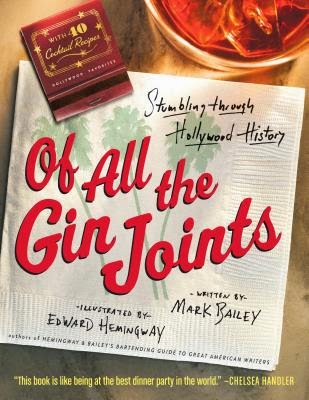
Of All the Gin Joints
by Mark Bailey and Edward Hemingway

If you're a fan of the legends and lore of old Hollywood, or of the more recent golden age of Natalie Wood, Dennis Hopper, Liz and Dick, Frank Sinatra, and Marilyn Monroe, 'Of All the Gin Joints' is a great gift book for you or that movie buff you know.

The book begins with the silent movie era with stories about such luminaries as Fatty Arbuckle, John Barrymore, Clara Bow, and Louise Brooks. Following tales of their exploits, a drink recipe is printed along with a feature on the famous bars and hotels where the stars imbibed. Here's one thing I learned after reading this book: Charlie Sheen and Lindsey Lohan did not invent Hollywood partying to excess. Tallulah Bankhead, Richard Burton, and Errol Flynn ran wild at night (and day) and staggered into their close-ups by morning. And while it may sound decadent and adventurous to take an actual champagne bath, it didn't end so happily for Natalie Wood. It seems that champagne burned rather than tickled the intended areas. 

There's also a story -- believe it or not -- about how John Wayne may have been one of the inventors of the Margarita. There's a good recipe for that classic drink as well. If you've ever had the pleasure of having a Mai Tai at Trader Vic's, you'll enjoy reading about the history of the chain. But it wasn't the first American Tiki bar. Don's Beachcomber takes that honor. If you had a drink called 'The Zombie' there, hopefully you remember it. Judging by the recipe, it's not for beginners. 

Saturday, January 3, 2015

San Francisco Days, San Francisco Night: A Book Review by Pete

When I look out my window
many sights to see.
And when I look in my window
so many different people to be. 
That it's strange
so strange

The song 'Season of the Witch' by Donovan

Season of the Witch, a book by David Talbot, covers the wild history of San Francisco from roughly the Summer of Love in 1967 to the late 1980's post HIV/AIDS crisis. To refer to that era as colorful is indeed an understatement. It seemed as if everything but a major earthquake shook the city back then, and its pieces were scattered everywhere. Scott McKenzie sang 'If you're going to San Francisco, be sure to wear some flowers in your hair.' The hippies came in droves in search of free love and drug experimentation. But the party had to end sometime, and many revelers succumbed to std's and overdoses.

The hippies weren't the only ones clashing cultures with the old Italian/Irish Catholic power structure of the time. Next came anti-war in Vietnam protesters, race riots and other civil rights demonstrations, neighborhood gentrification, porn theaters, radical anarchists, Patty Hearst, the Jim Jones cult, and the assassinations of Mayor Moscone and Supervisor Harvey Milk. But bright spots also emerged within the cataclysm. San Francisco was on the leading edge of the locally grown food movement, grew into a place of tolerance for gay and transgender individuals, became a model for compassionate healthcare for those afflicted with HIV/AIDS, and even witnessed the unlikely rise of Joe Montana and the Super Bowl winning San Francisco 49ers. 


I've only visited San Francisco a few times, but after reading this amazing historical account I certainly need to visit again. For despite all its calamities, The City by the Bay is indeed a resilient and beautiful national treasure. 

Below, are some pictures from Miki's most recent trips to San Francisco.  Perhaps you can share with us your San Francisco experience...


Picture of the city from The Legion of Honor Museum 

View of the Golden Gate Bridge from the Legion of Honor Museum
City Lights Books and Jack Kerouac Way in China Town

A Boutique in the Haight Ashbury District

Tuesday, November 25, 2014

Pete has a new book review

A Review of Erik Larson’s In the Garden of Beasts
By Pete Schulte

In the year 1933 a US Ambassador was needed, but interest in the esteemed position was scant. For the position was US Ambassador to Germany, Nazi Germany. William E. Dodd wasn’t anyone’s first choice for the job, probably not even second or third. But somebody had to do it, and Dodd did study for a time in Germany and knew the language. Ambassadors in those days were usually men of wealth and extravagance. Dodd had neither of these attributes. He had a teaching background and was thrifty nearly to a fault. His American cohorts didn’t particularly care for him, and the Germans weren’t too impressed either. By all accounts, one would think Dodd was exactly the wrong person for the job. But there was a strength Dodd possessed that cannot be disputed. He had a vast historical knowledge, and based on this knowledge he knew that something had gone very wrong in Germany, and it was just going to get worse. Would anyone listen?

In contrast to Dodd’s reserve and thrift was his daughter, Martha, who came with the family to Germany. Martha was up for any party and dated a Gestapo officer, a Russian agent, as well as a variety of writers, bankers, diplomats, etc…She even had her hand kissed by Hitler himself.

Martha, dizzy from all the attention and excitement, took a long while to understand the gravity and seriousness of what the Nazis intended to do. But as ambassador, Dodd was hearing about people imprisoned without a trial ‘for their own protection,’ Jews being mistreated and subject to cruel new laws, and even visiting Americans being pummeled for not using the Nazi salute.


In those dark days, Americans were in the midst of the great Depression and had little interest in what was going on overseas. The government, too, had more interest in Germany repaying its debt than hearing about ‘isolated instances’ concerning the disappearances of Jews, Communists, or other perceived enemies of the state. The book’s author, Erik Larson, does an incredible job of bringing these ominous and dangerous pre-war times to life. You may not like Dodd after reading this, and likely not Martha either. But any shortcomings they had pale in comparison to the dark Nazi hearts In the Garden of Beasts.

Tuesday, November 4, 2014

Pete gives Killer Angels rave reviews


Killer Angels is Michael Shaara’s Pulitzer Prize winning novel about the three day battle of Gettysburg (July 1 - 3, 1863) during the Civil War. The story is told from the point of view of a variety of combatants including Robert E. Lee, Joshua Chamberlain, James Longstreet, John Buford, and George Pickett, who led the famous, ill-fated charge of the Union line during the battle’s culmination. 

If you have any interest in the Civil War or American history in general, I would strongly recommend this book. It’s easily one of the best novels about warfare that I’ve ever read. You really get the feeling of being there, on both sides, and what it may have been like as an officer, bestowed with great power but also burdened with brutal decisions that could mean life or death. Or just to be a regular soldier, marching across open fields against volleys of gunfire, ducking under a rain of cannonballs, stepping on or over fallen men and dead horses.


War is hell they say, and it certainly seemed as much for the majority of soldiers at Gettysburg. But as far as the book goes, the prose sure is beautiful. It’s an interesting contrast: Here we have a beautiful telling of a horrible war. There were at least 50,000 casualties if you total up both sides after three days of fighting. And then the guns fell silent. July 4th was the very next day. 

Thursday, October 9, 2014

A Review of a Beautiful Era by Pete Schulte

Image courtesy of Tatteredcover.com
Twilight of the Belle Epoque
By Mary McAuliffe

I became interested in the Belle Epoque era (the glory years in France from 1870 to the First World War) after seeing the Woody Allen film ‘Midnight in Paris.’ In the movie, the main character is transported back in time to his favorite era, the roaring 20’s of Hemingway, Fitzgerald, Dali, and others. Later in the film, one of the other characters wishes to be transported even further back in time to her favorite era, the Belle Epoque. If I had to choose between the two, I believe I would take the Belle Epoque as well.

Twilight of the Belle Epoque covers the dawn of the 20th century to the chaos and destruction of WWI. In the art world, this was the age of Picasso, Matisse, and Marc Chagall. In music, there was Debussy, Ravel, Satie, Stravinski, and Lili Boulanger. In dance there was Isadora Duncan, while on stage there was Sarah Bernhardt. In science, Marie Curie was winning the Nobel Prize, while auto giants Renault, Citroen, and Michelin were transforming the way we travel. The author reminds us, however, that although this was indeed one of the golden ages for art and discovery, there was also rampant poverty, struggles between church and state, rising anti-Semitism, and growing nationalism that helped stoke the fires of WWI.


This book was such fun to read, and I learned so much in the process. One of the most interesting sections was when Gertrude Stein arrived from America with her family, and they had the forethought to start collecting art from then little known Picasso and Matisse. It was also interesting how most of the artists and musicians served during wartime, in battle or on the home front. One composer came back with only one arm and began composing symphonies for the left hand only. Still, others did not come home at all, or were too badly injured to carry on in the arts. Like the movie, Midnight in Paris, I too felt transported into another era. I only reluctantly return to my own. I have my own paintings to do after all. 

Saturday, August 30, 2014

A Pulp Fiction Review by Pete

Borderline
Photo Courtesy of Tattered Cover Book Store

Borderline
By Lawrence Block 

I love reading pulp fiction, especially when traveling. Things happen, usually right off the bat. Bad guys, often without hope for redemption, emerge from the shadows to do their worst. And average Joes of both sexes -- maybe looking for a little edgy excitement -- get in over their heads in a hurry. Borderline is one of the many novels and short stories I’ve read of late by Hard Case Crime, a publishing house that has brought back pulp fiction classics and the provocative covers that drew you into its sordid pages.


Borderline tells the story of four flawed characters and one sadistic serial killer along the hot and sweaty border towns of El Paso and Juarez. Tequila flows, gamblers gamble, and the sex is pretty steamy. This novel is not for the squeamish, however. The killer takes great pleasure in his slicing and dicing and the reader is spared no details. But if you are a fan of pulp fiction, or if you dare to take a peek, this Borderline had my blood pumping from the get-go to the end; it even had a few good bonus stories for you after the bloody finale. 

Thursday, August 28, 2014

Finally, Miki writes a book review!


Reading Devil in the White City
a review by Miki Schulte

The Devil in the White City: Murder, Magic, and Madness at the Fair that Changed America
Image courtesy of Tattered Cover

Although I am often described as bubbly and always smiling, most people who know me well know that I am obsessed with forensics, serial killer stories, dark tales, and the macabre.  Well, I think I may have just the book that brings all of these not so secret obsessions together. 
The Alienist

The Devil in the White City was one of those books that I shelved and sold regularly, but never really got the motivation to pick up and read.  However, after reading The Alienist by Caleb Carr, I finally took the plunge.

In The Alienist, the main character is using research, newspapers, behaviors, and interviews from famous murder cases to try and catch one of the most elusive serial killers ever know to New York City.  Although The Alienist is fiction, the cases mentioned were real.  One of those cases was that of H.H. Holmes. 

Holmes, whose real last name was Mudgett, was a young man drawn to the busy bustling city of Chicago.  In the chaos of a city preparing for the World Fair, Holmes saw an opportunity, an opportunity to lure in victims and spit them out into a city unaware of his capabilities.  Because crime was so high and so many people were heading into Chicago to get a new start, Holmes was able to kill dozens of people without ever being detected.  He was also handsome and charming, so when suspicions arose among the families of the missing victims, he often put them at ease with a tale full of lies and a trail that led them to a dead end.

The story of Holmes explains the Devil part of the title, but the white city is also a huge part of the story.  This part of the title is referring to the section of Chicago that was built for the World’s Fair.  Although this part of the story is not full of murder and mayhem, it is jam packed with drama (and a body count).  Erik Larson is a historian, but he is also darn good story teller.  He shows the reader the struggles, the tragedies, and the miracles that went into creating one of the biggest events in American history.

Not only does he tell the story of the fair, but Larson introduces us to the men and women that somehow made the fair a success.  From the main architect to the inventor of the Ferris Wheel to the female architect on site, a wide range of stories are told.  So many names involved with the fair changed American history.  Not only that, but the number of lives lost working on the fair rivaled those who fell victim to the charms of H.H. Holmes. 

These two riveting stories somehow fit into this one book.  I don’t know how Erik Larson does it, but he does it fabulously.  As someone who drags their heels into reading non-fiction, I am still surprised how much I enjoyed the book and how fast I plowed through the pages.  This is a must read for any history lover, but it was also so well written, fiction lovers would enjoy it tool.

Monday, August 11, 2014

In Case You Missed It...The New Murakami Comes Out Tomorrow!


Colorless Tsukuru Tazaki and His Years of Pilgrimage: A novel

Colorless Tsukuru Tazaki and His Years of Pilgrimage (a novel by Haruki Murakami)

I confess I wasn't able to finish Murakami's prior novel '1Q84,' dropping off somewhere beyond the halfway point. But that was one giant book, and I am happy to report that the only thing giant about his latest novel 'Colorless Tsukuru Tazaki and His Years of Pilgrimage' is the title, which is explained in full early on in the story. In contrast to '1Q84,' Murakami's new novel is much shorter in length (Thank God), and much simpler in plot. I would also add that it's one of the most joyful reading experiences I've had in quite some time. Murakami has already won himself quite a few awards, but I think this novel pushes him ever closer to Nobel territory.

As I've written, the plot is simple. Five high school friends (three boys, two girls) form an exclusive, intimate friendship, though without sexual attraction (or so the narrator perceives). The group is inseparable until Colorless Tsukuru leaves town to attend a university in Tokyo where he studies the building of train stations. Everything is okay during his visits home at first, but come spring a trip home results in the altering of his life forever. Tsukuru returns to his home town and finds that the other four will not talk to him, will not see him, and have entirely banished him for apparently no reason. He falls into a horrible depression, loses weight, and begs for his heart to just stop beating. But it doesn't.

Flash forward 16 years later and Tsukuru is building train stations and has a new person in his life. But his girlfriend, Sara, notices that his banishment from the group all those years ago is still nagging at his present, holding him back somehow. Sara pushes him to find each member of his former group to pinpoint just what the hell happened. This is the story of 'Colorless Tsukuru Tazaki and His Years of Pilgrimage,' a pilgrimage more mental than physical, and yet still takes him from Tokyo all the way to Finland of all places. As Tsukuru finds out, the truth can hurt, badly, but as the saying goes, it'll also set you free.

Sunday, July 27, 2014

A review of the Great Bridge by David McCullough


It’s actually cheaper to walk across the Brooklyn Bridge now than when it opened for business in 1883. When I crossed earlier in the year it was free of charge, but when the bridge opened it cost a full penny – and a few extra if you had farm animals in tow. The Great Bridge, by David McCullough, tells the epic story of the building of the bridge, a nearly 14 year journey to erect the longest suspension bridge the world had ever seen. To this day the iconic bridge remains in great shape, though several other bridges have long since surpassed its considerable length.

They say maybe 20 men died in the construction of the bridge, but those figures are not exact. Though there were painstaking records kept even in those days, for some reason those who lived and those who died were not one of them. Perhaps it’s because the wounds from the Civil War were still fresh during the bridge’s construction. America was used to death and dying. And, in comparison to some cities where they used the volatile and explosive nitroglycerin, losing 20 men was nothing. A dig in Boston resulted in over 300 dead. This was also an era of significant immigration. New residents were hungry for work no matter what the consequences.

The Great Bridge is mainly the story of its chief engineers, father and son John and Washington Roebling.  John, the patriarch, was an immigrant German with a talent for building – especially bridges – and had a work ethic and willpower to see his projects through. The younger Washington was a Civil War officer who shared his father’s passions, and who rose to the occasion after John passed away in a freak accident as the bridge construction was in its infancy.


I would urge anyone visiting New York City to take a stroll across the Brooklyn Bridge. You really feel the history in your bones, and the views in all directions are spectacular. I would equate the Brooklyn Bridge experience with the feeling one gets when entering a great cathedral. All the feelings of beauty, enormity, and the pride of human achievement come flooding inside along with the mourning for the departed. It’s a good feeling.  It’s an incredible bridge.


Monday, June 30, 2014

Jojo Moyes has a new novel and Miki wants you to read it!!!

One Plus One by Jojo Moyes
One Sale July 1, 2014
978-0-525-42658-5
One Plus One
It is no secret around here that I am a huge fan of Jojo Moyes.  I have been recommending Me Before You to anyone who crosses my path.  Luckily for those around me, I have a new book to talk about.  One Plus One is the newest novel by Jojo Moyes.  Moyes brings us a brand new story filled to the brim with those quirky, train wreck type characters that we have grown so fond of in her writing.  Moyes has a wonderful way of creating characters that are totally crazy sometimes tragic, but not so much so that we can’t relate.  Her characters have enough vulnerability to make them real, but enough dysfunction, that we are glad to be ourselves as we read about their lives. 

In this novel, we meet Jess, a single mom raising her nerdy daughter and outcast step-son.  Their father has walked out on them, leaving them to deal with the financial mess he has left in his wake.  Jess is forced to pick up the pieces by picking up after other people.  At one of her housekeeping jobs, she comes across the rather wealthy and rude Ed Nicholls.  Once their paths cross, Jess finds that their lives will continue to criss cross. 

Although Jess and Ed’s lives are the main focus of the novel, Tanzie, Jess’s math whiz daughter, is really the scene stealer in this novel.  Jess goes on a mission to get Tanzie to a math competition in Scotland in order to get a scholarship for an elite school they cannot afford.  While Jess’s struggle to do right by her kids is a fantastic story, it is Tanzie’s observations and naiveté really make the novel a delight to read. 


I really enjoyed this novel and will happily recommend yet another Moyes novel to anyone willing to listen.

Saturday, May 17, 2014

Pete's Review of Bird Box by Josh Malerman


Bird Box


Here is what happens when there's something outside so indescribably terrifying that simply laying your eyes on it -- or them -- causes insanity, suicide, homicide, or a mixture of all. You stay inside. And not only do you stay inside, you board up the windows too. One must be blindfolded when outside excursions are completely necessary, or pay the horrible cost.
 

In Josh Malerman's debut novel, Malorie is living alone with her sister when internet reports first surface about weird suicidal/homicidal happenings in Russia. Trouble is, these happenings are spreading and spreading fast. And, what timing, Malorie has just found out she's pregnant. The situation deteriorates from there to the point where her up-state parents no longer answer the phone. Are they dead? And later she calls to her sister in the other room and there is no answer. She walks down the hall to the bathroom, calling. She sees...
 

Malorie is in survival mode by this point. Everybody is. The lucky ones stumble into homes where other survivors have gathered. This novel tells the story of one such home and its random occupants. Some of them use unbelievable cunning in attempts to understand and confront what's happening, while others devolve into fighting among themselves for whatever scraps remain.
 

Certain questions arise. If you're already insane, do you have immunity from this thing, these creatures, or whatever they are? Are animals and pets impacted? What if it's all just a mass-hysteria brought on by a collective fear? What if you believe your mind superior to what's out there? Don't believe it? Open the door and lower your blindfold...if you dare.
 

I'm a slow reader but burned through this one fast. If I set a goal to read two chapters, I'd read four. If I vowed to stop reading at midnight, I'd continue on until two. I found the book frightening, suspenseful, thought-provoking, and in a weird way a lot of fun. I couldn't believe how cool the ending was, and for a long time after that I was simply in awe.

Thursday, May 8, 2014

Pete has a new book review for you...


Lovers at the Chameleon Club, Paris 1932


I'm a big fan of Berlin Stories by Christopher Isherwood, which later became a stage musical and eventually the film Cabaret. Lovers at the Chameleon Club, Paris 1932, a novel by Francine Prose, takes place in roughly the same era but different city. The depression lingers, the Germans are threatening, but at the Chameleon Club you can be whatever you want to be. A budding photographer takes the picture of a sultry woman with her lesbian lover who dresses as a man in a tuxedo. But who are these women really, and what becomes of them when Paris becomes occupied by the Germans in 1940? 

The story is told from several points of view including the photographer's letters home, from a struggling American writer (think Henry Miller), from a biographer interested in the story of Lou Villars, the woman who wanted to dress as a man (not so easy in those days) but ended up as a tool for the Gestapo, and from a wealthy baroness, who married a homosexual automaker but is in love with the photographer who snapped the photo 'Lovers at the Chameleon Club, Paris 1932' (or, by its real life name: Lesbian Couple at Le Monocle, 1932). 

Not only was this is novel a joy to read, but it's also based on true events. Like me, you'll probably want to see who the real Lou was, and was that really Henry Miller sitting at a bar with Picasso? You'll no doubt want to learn about the photographer in question ( in real life, Brassai) and view the much discussed photographs. They're quite beautiful. 

I so look forward to recommending this book. From the titular photograph, it's hard to have an opinion one way or another about Lou Villars. All she wanted to do was dress like a man. But maybe there was something else lurking in her heart, or maybe it's more likely that she had no heart at all.